# 5 Steps To Declutter Kitchen Cabinets Quickly
## Introduction: The Importance of a Clutter-Free Kitchen
The kitchen is often referred to as the heart of the home. It is where meals are prepared, families gather, and memories are made over shared plates of food. However, for many homeowners and renters alike, this central space can easily transform into a source of frustration rather than joy. When your kitchen cabinets are overflowing with mismatched tupperware, expired spices, and gadgets you haven’t touched in years, finding what you need becomes a scavenger hunt that eats into your precious morning coffee time.
There is a profound link between physical clutter and mental clutter. Studies suggest that disorganized environments can increase cortisol levels, leading to heightened stress and anxiety. A cluttered kitchen creates “visual noise,” making it difficult to focus on the task at hand: cooking. Furthermore, when items are buried deep behind other objects, they end up getting forgotten until they expire or break, resulting in financial waste and unnecessary grocery runs for things you already own.
By committing to a decluttering project, you unlock several tangible benefits:
* **Time Efficiency:** You spend less time searching for measuring cups or specific spices, allowing for smoother meal prep routines.
* **Stress Reduction:** A tidy space fosters a sense of calm and control, turning the act of cooking into a relaxing ritual rather than a chore.
* **Enhanced Safety:** Removing broken ceramics or expired foods reduces hazards. Keeping heavy items lower prevents accidents.
* **Improved Efficiency:** Strategic placement of items based on frequency of use streamlines the workflow.
In this guide, we will walk you through five essential steps to transform your chaotic kitchen cabinets into a model of order and functionality. Whether you have a spacious gourmet kitchen or a compact galley, these principles apply universally. Let’s dive in and reclaim your culinary sanctuary.
## Step 1: Gather Supplies and Clear All Shelves
Before you can organize, you must empty. This is the most critical preparation phase that sets the tone for the rest of the project. Rushing into sorting items without proper preparation leads to unfinished tasks and scattered debris. Approach this step with the mindset of a project manager. You need the right arsenal of tools to make the work efficient.
### Assembling Your Toolkit
First, head to the utility room or garage to gather the necessary supplies. Do not attempt this with half-used rags or old sponges; invest in dedicated cleaning gear for this task.
* **Heavy-Duty Trash Bags:** You need large bags specifically designated for trash. Having multiple bags is helpful to separate garbage, donations, and recyclables immediately.
* **Cleaning Solution:** Mix a solution of warm water and mild dish soap for general grime, or vinegar and baking soda for sticky residues. Microfiber cloths are superior to paper towels here as they capture dust without leaving lint.
* **Bins and Baskets:** Even before deciding what stays, having empty clear bins helps visualize the volume of items. Some people prefer buying temporary storage containers to hold items once cleaned.
* **Protective Gear:** Rubber gloves are essential for handling dirty pots and harsh chemicals. Knee pads might be useful if you are working on low shelves frequently.
### The Emptying Process
Start with one cabinet at a time. Do not attempt to tackle all cupboards simultaneously; it becomes overwhelming physically and mentally. Take out everything from the targeted cabinet—pots, pans, lids, dry goods, and utensils. Place these items directly onto a clear surface in the dining area or on a large kitchen island counter.
Emptying completely allows you to see the actual capacity of your storage. Often, we underestimate how much space we think we have versus reality. As you remove items, inspect the shelving unit itself. Is there grease splattered on the side walls? Are there stickers left behind? Are there signs of mold or pest intrusion in the corners?
Take this moment to inspect the cabinetry hardware. Are hinges squeaking? Are drawer slides sticky? While you shouldn’t overhaul the cabinets entirely unless planned, note any repairs needed so you can address them after the declutter is complete. Once the cabinet is bone dry and bare, take a photo. This “after shot” will serve as a powerful motivation later when you fill it up neatly.
### Creating a Temporary Holding Area
As you pull items out, resist the urge to put them immediately back into another cabinet across the room. Instead, lay them out on your floor or table. Group them loosely by type to begin the mental shift from “cabinet holder” to “reviewer.” This separation creates psychological distance from the storage constraint, helping you make objective decisions rather than just trying to force things to fit again.
## Step 2: Sort Items and Identify Categories
Now that everything is out, the second phase begins: categorization. Humans love patterns, but kitchens often defy them because we stuff random items into available voids. The goal here is to bring chaos under control by grouping similar functions together.
### The Zoning Method
Instead of thinking about cabinets, think about zones. In a functional kitchen, items are placed where they are used. Divide your loose pile of items into broad categories:
* **Cooking Essentials:** Pots, pans, spatulas, ladles, wooden spoons, and cutting boards.
* **Baking Supplies:** Measuring cups, cake pans, rolling pins, mixers, parchment paper, and flour/sugar storage containers.
* **Food Storage:** Tupperware containers, aluminum foil, plastic wrap, ziplock bags, and lids.
* **Pantry Staples:** Spices, canned goods, rice, pasta, oils, and condiments.
* **Appliances:** Toasters, blenders, slow cookers, and microwaves.
* **Glassware/Dinnerware:** Plates, bowls, mugs, drinking glasses, and stemware.
### Inspecting for Expiration and Condition
With your categories established, you must inspect every single item individually. This is tedious but non-negotiable for a truly decluttered kitchen.
* **Check Dates:** Open spice jars, cans, and packets. If a spice lost its scent three years ago, discard it. Expired condiments often harbor bacteria. Old baking powder or yeast won’t rise properly. Note: Unopened pantry staples like flour or oats last longer, but once opened, transfer them to sealed containers to prevent pests.
* **Assess Utensil Health:** Look for worn-out spatulas that leave silicone bits in your food or wooden spoons that smell like old soup even after washing. If an item is broken, chipped, or missing its counterpart (like a lid), ask yourself how much you truly rely on it. Chipped ceramic dishes can harbor bacteria and aren’t safe for health reasons; they belong in the donation box or trash, not the cabinet.
### Identifying Unused Frequency
Look at your appliances and specialized tools. The average household owns far more gadgets than they use. Ask yourself honestly: When was the last time you used this? If you haven’t used an ice cream maker in four years since that one trip to the store, it doesn’t belong in your prime real estate. Similarly, duplicate items like four different brands of salt shakers should be consolidated to save space. Consolidation isn’t just about quantity; it’s about uniformity. Having three identical spice jars looks cleaner than three different shapes and colors.
## Step 3: Decide What to Keep, Donate, or Trash
Once sorted, the hardest part arises: decision-making. This is where discipline meets lifestyle management. You must determine the fate of every item based on its utility, emotional value, and condition.
### The Decision Matrix
Adopt a triage system for your items:
1. **Keep:** Items used weekly or daily, or those with significant sentimental value (e.g., a heirloom platter).
2. **Donate:** Items in good condition but rarely used. Think guest serving dishes, small appliances you received as gifts but never liked, or duplicates you don’t need.
3. **Trash:** Broken, chipped, expired, or stained items that cannot be sold.
### Handling Sentimental Items
A common obstacle is emotional attachment. You may hold onto grandma’s casserole dish because you miss her, even if you cook in the microwave more than the oven now. This is where photography comes in handy. Take a picture of the sentimental item to preserve the memory, then let it go physically. Remember, the memory is stored in your mind, not in the china cabinet. If you want to keep it as a display piece, give it a place of honor on a top shelf or in a glass-front cabinet, rather than hiding it behind junk.
### Donation Strategies
For the “Donate” pile, act fast. Bag it immediately. Do not let it sit on the counter for weeks. Research local charities, community centers, or thrift stores that accept kitchenware. Many organizations appreciate clean, working appliances, particularly blenders or toasters which are expensive to replace for families in need. If you’re selling high-quality brands, online marketplaces are an option, but ensure the cost of packaging outweighs the profit.
### The “Maybe” Box Rule
Sometimes, you just can’t decide. For these indecisive items, create a “Maybe” box. Put them in a box, seal it, and date it for three months from now. Set a reminder on your phone. If you haven’t opened the box by the date to retrieve anything inside, donate the entire box unopened. This trick bypasses the procrastination muscle by setting a deadline. Often, you will realize you forgot the items existed, which confirms they weren’t essentials.
## Step 4: Deep Clean Surfaces and Organize Layout
With the pile decided, it’s time to prepare the canvas. Now that you know exactly what fits, you can design the layout efficiently. This step combines sanitization with intelligent spatial planning.
### Sanitizing the Cabinet Interiors
You cannot organize dirty shelves. Remove crumbs, dust, and sticky spills from the bottom of the cabinets. Pay special attention to the corners where bugs might hide and the gaps between shelves.
* **Deodorize:** If smells persist (spice smells or grease), sprinkle baking soda at the bottom, let it sit overnight, and vacuum it up.
* **Wash Down:** Wipe shelves with a disinfectant wipe or damp cloth. If using vinegar, ensure wood finishes aren’t stripped by excess moisture. Dry thoroughly.
### Vertical Storage Solutions
Utilize vertical space to maximize capacity without needing more square footage.
* **Shelf Risers:** Buy adjustable shelf risers to create two levels of space for plates or bowls. This instantly doubles your plate storage in deep cupboards.
* **Tension Rods:** Install tension rods vertically inside a cabinet to separate baking sheets or cutting boards upright. This prevents stacking them horizontally where they get stuck behind one another.
* **Lazy Susans:** For corner cabinets or deep back shelves, rotating turntables are life-savers. They allow you to access sauces and bottles at the back without moving the front ones.
### Placement Strategy: The Golden Zone
Arrange your kept items based on ergonomic principles. The “Golden Zone” is the space between your hip and eye level.
* **High Priority:** Heavy, frequent-use items (daily spices, coffee maker, mugs) go in the Golden Zone. This reduces strain and time spent reaching up or bending down.
* **Medium Priority:** Occasional use items (specialty bakeware, party platters) go on top shelves or below counters where they are accessible but not in the way.
* **Low Priority:** Rarely used appliances (bread makers, fondue sets) belong on the very top or very bottom shelves, or in a less accessible garage cabinet.
### Containerizing Loose Items
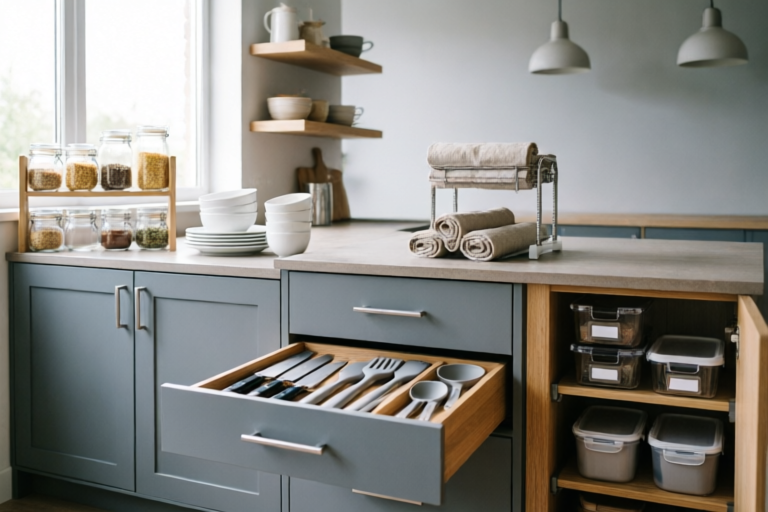
Loose items are the enemy of a neat look. Avoid keeping boxes of cereal or snacks inside the cabinet; transfer them to opaque canisters. This keeps bugs away and preserves freshness. Use drawer dividers for utensils to prevent the “ultra-drawer” spaghetti effect where everything jumbles together. Uniform labels for bins create a visual cue that helps everyone in the household return items correctly.
## Step 5: Establish Maintenance Habits
Decluttering is a one-time event; maintenance is a lifelong commitment. Without a system to protect your new order, clutter will inevitably creep back in within weeks. This step focuses on building sustainable habits.
### The One-In-One-Out Rule
To maintain balance, adopt the policy that for every new item brought into the kitchen, an old item must leave. Buying a new blender means donating the old one or discarding it. This rule forces mindful consumption and prevents the accumulation phase from restarting.
### Return Immediately Policy
Make it a non-negotiable habit to put items back where they belong the exact moment you finish using them. Do not leave a dirty bowl on the counter waiting for the dishwasher cycle. Do not stack plates in a pile on the drying rack forever. Assign a “bin” location for every category. If you leave something out, you create a visual reminder of chaos that discourages future organization.
### Monthly Mini-Checks
Set a calendar reminder for a quick monthly review. Spend 15 minutes doing a walkthrough of the pantry and cupboards.
* Check for expiring items.
* Realign labels.
* Clear away any stray wrappers that may have fallen in.
This micro-management prevents the feeling of being overwhelmed during the next big declutter session. It keeps the house running smoothly and ensures that you catch issues like pest infestations early.
## Conclusion: Maintain Order with Daily Habits
Successfully decluttering your kitchen cabinets is not just about aesthetics; it is about reclaiming your mental bandwidth and improving your quality of life. By following these five steps—preparing thoroughly, categorizing meticulously, making decisive choices, cleaning strategically, and maintaining consistently—you transform a stressful environment into a sanctuary of productivity.
Remember that perfection is not the goal; functionality is. Your kitchen should serve you, not the other way around. If you find yourself reverting to old habits, do not beat yourself up. Re-evaluate your zones, perhaps adjust your containers, or tighten up the maintenance routine. The journey to a perfectly organized kitchen is iterative. Celebrate your progress, enjoy the smooth workflow, and most importantly, share the joy of a clutter-free space with those who cook with you.
Start today. Pick one cabinet, and apply Step 1. Before you know it, your entire kitchen will be operating like a well-oiled machine, ready to support your culinary adventures.